The Numbered Blueprint of Your Soul
Study the Pythagorean tradition and the symbolic meanings of numbers.
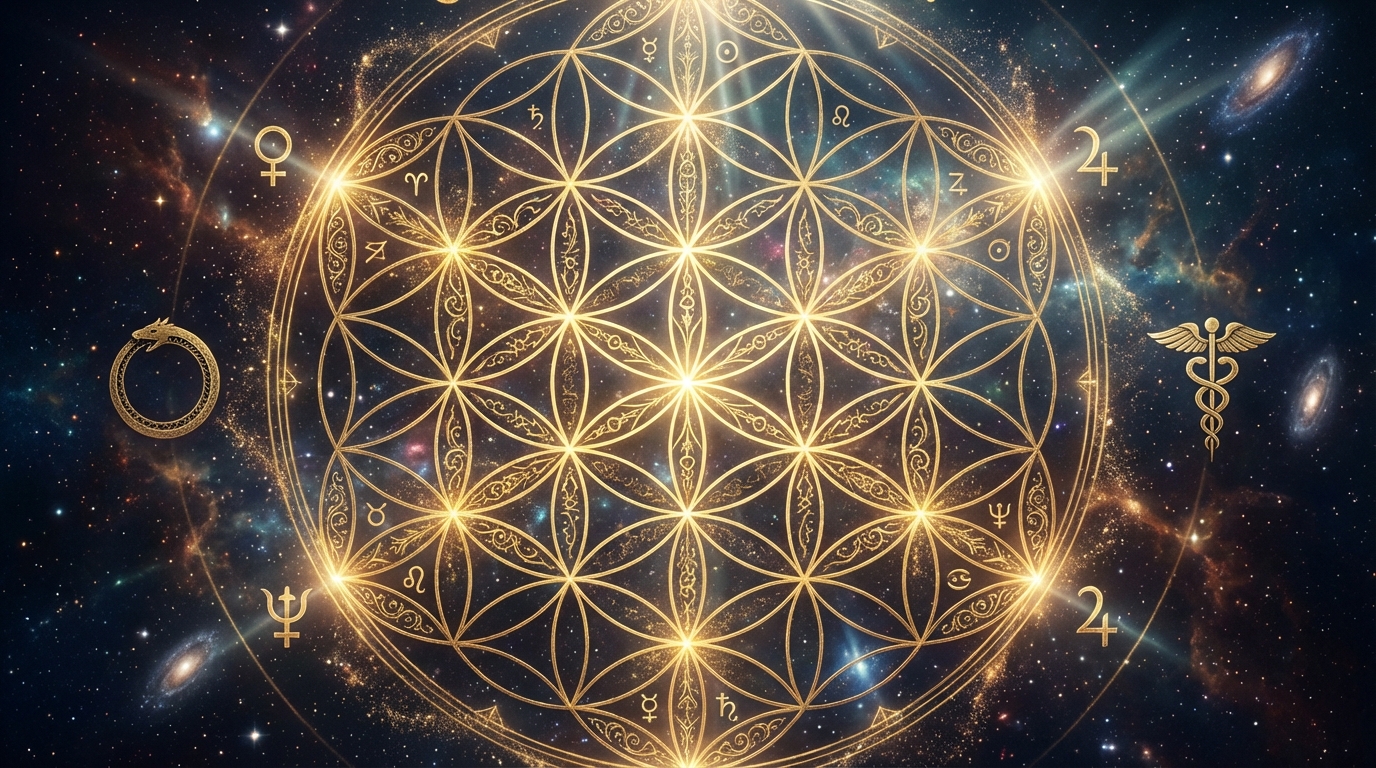
The mathematical language of the soul: Deciphering the Flower of Life.
Historical Origins
The perception of numbers as divine entities traces its lineage to the ancient mathematical mystery schools of Samos and Croton. Pythagoras, the "Father of Numbers," taught that the universe was constructed upon a foundation of absolute numerical ratios. This was not a secular mathematics but a sacred "Arithmology," where each number was seen as a specific deity or "intelligence" (Archai) that governed a particular aspect of reality.
This tradition was further developed in the Platonic and Neopythagorean schools, where the "Monad" (the One) was identified with the Divine Mind. During the Middle Ages, this knowledge was preserved through the Kabbalistic study of *Gematria*—the numerical value of words—which allowed for the decoding of hidden meanings within sacred texts. In the Renaissance, scholars like Cornelius Agrippa codified these relationships into the "Magical Squares" and the grids of planetary influence that we still use today.
Symbolic Meaning
In the Arcanum, a number is a "Vertical Symbol." It describes a quality of being rather than a quantity of objects. The **Monad (1)** is the symbol of Unity and the Absolute; the **Dyad (2)** represents the birth of Duality and Selection; the **Triad (3)** is the symbol of Harmony and the first completion. Every number up to the **Decad (10)** represents a distinct phase in the unfolding of the divine plan.
The primary symbol of numerology is the **Tetractys**—a triangular figure consisting of ten points arranged in four rows. This single image encodes the entire Hermetic cosmology: the point (1), the line (2), the surface (3), and the solid (4). To contemplate such a symbol is to witness the progression of spirit into the third dimension, providing a visual map for the student to understand the mathematical necessity of all existence.
Hermetic Interpretation
Hermetic numerology interprets the universe as a "Vibrational Cipher." The principle of Rhythm teaches that everything has its tides and its cycles, and these cycles are governed by the Law of Number. When a Hermeticist looks at a planetary transit or a ritual structure, they are analyzing the "Interference Patterns" of different numerical frequencies. The goal is to identify the "Dominant Tone" of a given moment and align one's own vibration accordingly.
This relates directly to the concept of the "Logos" or the Creative Word. If the universe was "spoken" into existence, then numbers are the "phonemes" of that divine speech. By studying arithmology, the student is essentially learning the grammar of the Creator. This allows for the "Decoding of Fate"—the ability to see the underlying numerical structure of events and to navigate them with the precision of a master architect.
Practical Application
Practically, numerology is used for "Vibrational Diagnosis." By calculating the numerical value of names, dates, and locations, the practitioner can identify the "Resonance" of a particular path. This is not "fortune telling" but "vibrational analysis." If two numbers are in a "dissonant" relationship (such as the friction between a 4 and a 5), the practitioner knows that the path will require extra effort toward stability and discipline.
In ritual practice, numbers determine the "Geometry of Power." The number of candles, the number of circumambulations, and the timing of invocations are all determined by the numerical signature of the work. By adhering to these strict mathematical protocols, the ritualist ensures that their act is "Harmonically Correct," allowing the intended spiritual energy to flow without the resistance caused by numerical "dissonance."
Related Concepts
- Gematria: The Kabbalistic practice of assigning numerical values to letters to find hidden connections between different words and concepts.
- Sacred Geometry: The visual and spatial expression of numerical ratios (like the Golden Ratio or the Pi proportion).
- Harmonics: The study of how different numerical frequencies interact to create harmony or dissonance in the soul and the world.
- Arithmancy: The divinatory use of numbers to understand the character of an individual or the potential outcome of a situation.
In the Hermetic and Pythagorean traditions, numbers are not merely quantitative measures used for counting, but qualitative principles that underlie the very structure of the cosmos. To the initiate, a number is a "Divine Idea" made manifest—a geometric and vibrational signature that reveals the laws of creation, preservation, and transformation.
The study of **Arithmology** is the study of the One Law expressing itself through the Many. From the absolute unity of the Monad to the perfected totality of the Decad, each numerical vibration represents a specific stage in the descent of spirit into matter and its eventual ascent back to the Source. By contemplating the numbers, we learn to read the "Blueprint of the Grand Architect" and to align our own consciousness with the harmony of the spheres.
The Science of Numbers
An overview of Pythagorean numerology and the metaphysical properties of numbers.
I. The Monad
The Number 1: Unity, Origin, and the Indivisible Point.
II. The Dyad
The Number 2: Duality, Reflection, and the First Polarity.
III. The Triad
The Number 3: Harmony, Equilibrium, and the Sacred Triangle.
IV. The Tetrad
The Number 4: Foundation, Stability, and the Four Elements.
V. The Pentad
The Number 5: Life, Vitality, and the Quintessence.
VI. The Hexad
The Number 6: Harmony, Beauty, and the Marriage of Opposites.
VII. The Heptad
The Number 7: Wisdom, Spirituality, and the Seven Spheres.
VIII. The Ogdoad
The Number 8: Regeneration, Abundance, and Eternal Rhythm.
IX. The Ennead
The Number 9: Completion, Universal Love, and the Horizon.
X. The Decad
The Number 10: Totality, Sovereign Power, and the Return to One.
The Pythagorean Tradition
Pythagoras of Samos, the primary architect of Western numerology, famously declared that "All is Number." For him and his followers, mathematics was not a secular tool but a spiritual discipline. The numbers were seen as the "gods" or "angels" of the universe—the primary forces through which the Divine One generated the manifold layers of reality. By mastering the relationships between numbers, the initiate could master the relationships between the forces of nature and the states of their own soul.
The Language of the Universe
Modern science has confirmed what the ancient sages always knew: that the universe is fundamentally mathematical. From the geometric structure of crystals and the orbital resonances of planets to the frequency of sound and the wavelength of light, number is the universal language. In this section of the ARCANUM library, we explore how these numerical keys can be used to unlock the deeper meanings of our own lives and the greater cycles of the world.